Custom Search


Using subquery in SELECT statement and WHERE clause
Inside This Tutorial Series
  1. Using subquery to return a single value
  2. Using subquery to return a list of values
  3. Using subquery to return one ore more rows of values
  4. Using correlated subqueries
  5. Using EXISTS and NOT EXISTS with correlated subqueries


Using subquery to return a list of values

When the subquery returns a list of values, the subquery is only evaluated once and then the list of values is returned to outer query to use. This kind of subqueries are also known as column subquery.

Column subquery is normally used in WHERE clause with an IN operator that tests each value in the returned list from the subquery.

Practice #1: Use subquery to return a list of values.

In Firefox (not IE), copy and paste the following SQL to your SQLyog query window. To execute a query, move your cursor anywhere inside the query and then press F9. Note that the SQL needs to end with semi-colon.

/*
This query retrieves a list of customers that made
purchases after the date 1998-05-01.

The subquery returns a list of CustomerIDs which is
used in outer query.
*/
select CustomerID, CompanyName
from customers
where CustomerID in
(
select CustomerID
from orders
where orderDate > '1998-05-01'
);

/*
This query returns the same result as query above
because the list of CustomerIDs are used rather than
the subquery.
*/
select CustomerID, CompanyName
from customers
where CustomerID in
(
'BONAP',
'DRACD',
'ERNSH',
'LEHMS',
'LILAS',
'PERIC',
'QUEEN',
'RATTC',
'RICSU',
'SIMOB',
'TORTU'
);

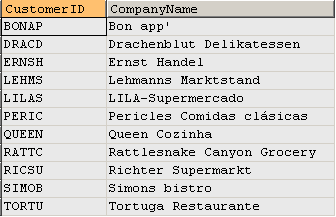
Query result set - 11 rows returned:
Use subquery to return a list of values.

Practice #2: Use inner join to return the same result as using a subquery.

In Firefox (not IE), copy and paste the following SQL to your SQLyog query window. To execute a query, move your cursor anywhere inside the query and then press F9. Note that the SQL needs to end with semi-colon.

/*
This query returns the same result as the one
in Practice #1 but here no subquery is used.
Instead, we used inner join.

Often, a query that contains subqueries can be
rewritten as a join.

Using inner join allows the query optimizer to
retrieve data in the most efficient way.
*/
select a.CustomerID, a.CompanyName
from customers as a
inner join orders as b on a.CustomerID = b.CustomerID
where b.orderDate > '1998-05-01'

Query result set - 77 rows returned:
Use inner join to return the same result as using a subquery.


Copyright © 2010 GeeksEngine.com. All Rights Reserved.

This website is hosted by LunarPages.

No portion may be reproduced without my written permission. Software and hardware names mentioned on this site are registered trademarks of their respective companies. Should any right be infringed, it is totally unintentional. Drop me an email and I will promptly and gladly rectify it.

 
Home | Kung Fu Timer | Feedback | Terms of Use | Privacy Policy